
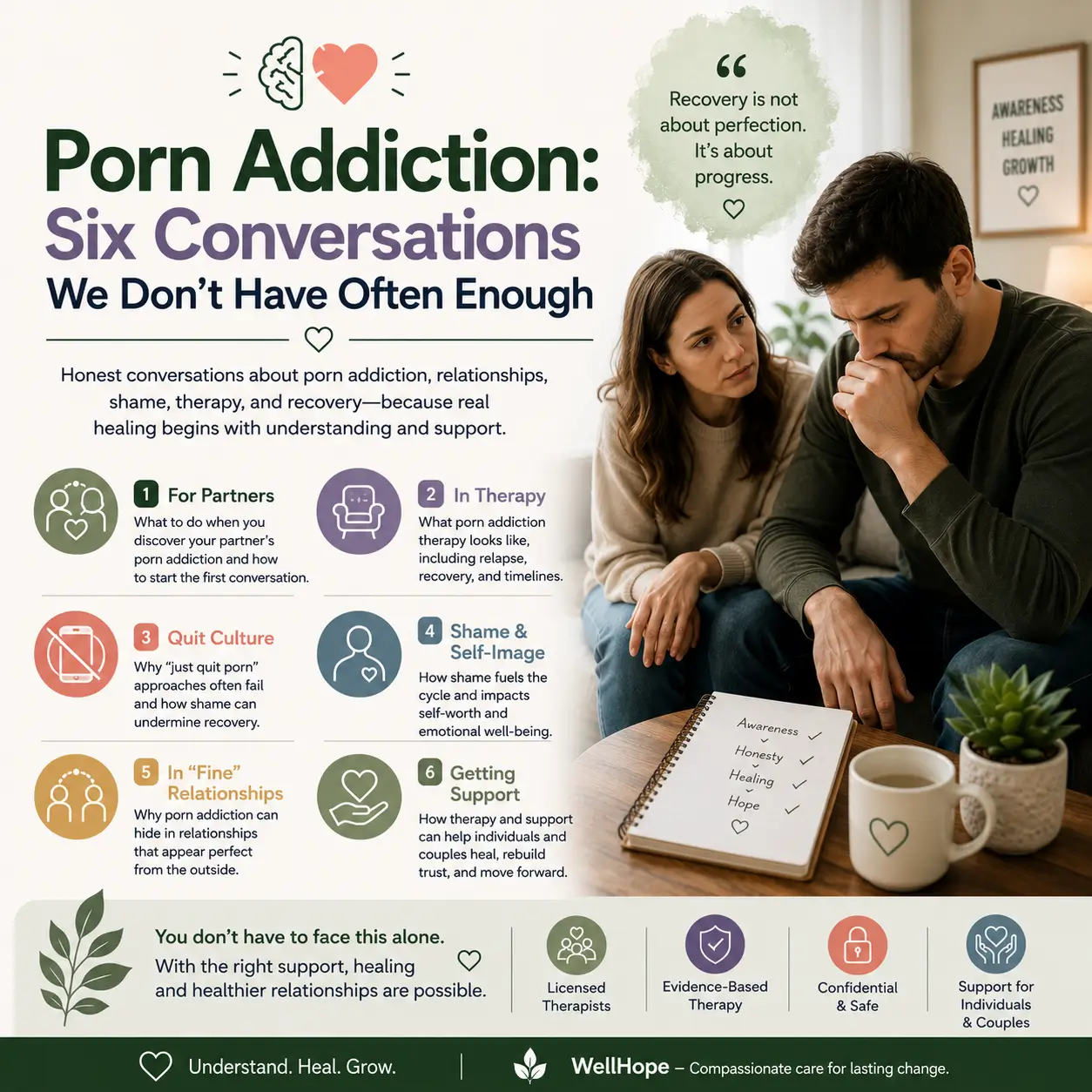
Porn Addiction: Six Conversations We Don't Have Often Enough | WellHope
At Well Hope, our counsellors work with people at every stage of porn addiction recovery from partners who've just found out, to individuals trying to understand what's driving the behaviour, to couples rebuilding trust afterward. Below are six conversations about porn addiction that don't usually make it into the standard overview article, plus the signs of porn addiction worth knowing whichever side of it you're on. If you're looking for a sex therapist online in India, Well Hope offers confidential online therapy.
- My Partner Has a Porn Addiction: What Should You Do?
Discovering a partner's porn addiction almost never arrives as one clean moment of clarity. It comes in waves, and every one of them is allowed to happen.
- The Emotional Stages of Discovery — First there's shock. Then, almost immediately, self-doubt creeps in — was I not enough? did I miss something? After the shock, anger tends to show up. Sometimes grief. Sometimes just a strange, flat numbness. All of it is a normal reaction to a real breach of trust, and none of it needs to be rushed through on anyone else's timeline.
- Why This Isn't a Reflection of Your Worth — Porn addiction is not a verdict on your attractiveness or your worth. It's a coping mechanism your partner built long before they met you, in response to something that had nothing to do with the relationship at all.
- How to Start the First Conversation — The first real conversation matters more than people expect it to. It rarely goes well when it happens in the heat of discovery — giving yourself even a day to steady yourself usually leads somewhere more honest than confronting it mid-panic does. Lead with what you noticed and how it affected you rather than an accusation, and let your partner respond without either of you needing to resolve everything in one sitting.
- Individual Counselling vs. Couples Counselling — Individual counselling for the partner who found out is often the right first move, especially while trust still needs rebuilding. Couples counselling and sex counselling can help partners rebuild communication, intimacy, and trust after compulsive pornography use has affected the relationship, but this tends to work better once both people have some individual footing first — otherwise the addiction quietly takes over every joint session, and the partner's own experience gets pushed to the side.
You're allowed to ask questions, and you're allowed to need time before deciding anything. Neither instant forgiveness nor an instant ultimatum is required of you. Most partners find clarity comes slowly — through honest conversation, through therapy, and through watching whether words are matched by consistent action over time.
- What Actually Happens in Porn Addiction Therapy?
A lot of the hesitation around seeking porn addiction help just comes down to not knowing what it looks like. It's rarely as clinical, or as confrontational, as people picture.
- What to Expect in the First Session — A first session usually feels more like a conversation than an interrogation — when the behaviour started, what it tends to respond to (stress, boredom, loneliness, conflict), what's already been tried. From there, therapy usually blends psychoeducation with practical, CBT-informed work: naming specific triggers, building alternatives to reach for instead, and slowly loosening the automatic link between the urge and the behaviour that used to follow it without question.
- How Relapse Is Handled in Recovery — Relapse gets treated as information, not failure. A slip usually points to something useful — a trigger nobody accounted for, a coping tool that wasn't strong enough yet — and a good therapist uses that to adjust the plan rather than treat it as proof the process has failed.
- Realistic Recovery Timelines — Timelines vary, but real change is rarely a matter of a handful of sessions. Most people notice genuine shifts over months rather than weeks, especially when the underlying driver — trauma, anxiety, low self-worth — needs its own attention alongside the behaviour itself. Progress tends to look uneven, not like a straight line up.
- Why "Just Quit Porn Cold Turkey" Culture Often Fails
A lot of people show up to therapy after they've already tried the internet's favourite fix for quitting — streaks, accountability apps, cold showers, sheer willpower. None of that is useless exactly; structure and accountability genuinely help some people. But on its own, it tends to fail, and for a pretty predictable reason.
- The Problem with Willpower-Only Approaches — It treats porn addiction like a discipline problem when it's usually functioning as a coping mechanism. Cut off the behaviour without replacing what it was actually doing — numbing stress, filling loneliness, offering some illusion of control — and you've just removed the outlet while the underlying need sits there, untouched.
- How Shame Undermines Recovery — Quit-culture spaces can be motivating, but they can also frame every single slip as a moral failure — which usually deepens the exact shame that was driving the behaviour to begin with. What's missing usually isn't more willpower; it's understanding what the behaviour was actually doing for the person.
- Porn Addiction, Shame, and Self-Image
One of the quieter effects of porn addiction is what it slowly does to how someone sees themselves. Shame doesn't just follow the behaviour over time; it becomes part of what keeps the cycle running.
- The Shame-Behaviour Cycle — The behaviour happens, shame follows, and instead of sitting with that shame, the person reaches for the same relief that caused it in the first place — because pornography, in the moment, still works to numb discomfort, even the discomfort of guilt itself. Each round reinforces the same growing belief: something is wrong with me.
- How It Affects Self-Worth — That belief rarely stays contained to sexual behaviour alone. It tends to bleed into body image, self-worth, and how deserving someone feels of connection or intimacy at all. Treating porn addiction usually has to involve untangling the self-image that built up around it too.
- Porn Addiction Hiding in a "Fine" Relationship
Some of the hardest cases to catch are the ones where nothing looks wrong at all. No obvious conflict, no visible distance, no dramatic moment — just a relationship that, from the outside, seems to be working perfectly well.
- Why It's Hard to Catch Early — Porn addiction doesn't need a broken relationship to take root — just privacy, and an unaddressed emotional need underneath. A missed deadline gets explained away. A late night quietly becomes routine. A partner's passing question gets a fast, reassuring answer instead of an honest one. It's usually only in hindsight that all the smaller signs get reassembled into a pattern.
- What Research Says About Porn Addiction and Relationship Mismatch — Research on couples shows the clearest damage doesn't come from porn simply being present in a relationship — it comes from a mismatch. Across a large sample of couples, the wider the gap between partners in how much they used porn, the lower their relationship satisfaction tended to be, and the shakier things got in terms of stability, conflict, and communication. Timing seems to matter too: when one partner used porn on days the couple also had sex, the other partner tended to report more sexual distress.
Getting Support for Porn Addiction at Well Hope
These situations don't call for the same response, but they share the same starting point — the earlier porn addiction gets named and talked about, the easier it is to work through, for the person struggling and for anyone standing beside them.
Professional support may include porn addiction therapy, sex therapy, individual counselling, or couples counselling, depending on the person's emotional needs and relationship concerns.
At Well Hope, our counsellors work with individuals and couples at every stage of porn addiction recovery — the partner who just found out, the person trying to understand what's underneath the behaviour, the relationship trying to rebuild after everything's already come to light. Wherever you're starting from, you don't have to figure it out alone. Recovery is not only about stopping compulsive behaviour — it's also about improving emotional wellbeing, healthier relationships, and long-term sexual wellness.
Whether you're looking for online sex therapy or in-person counselling, our team provides confidential support.
