
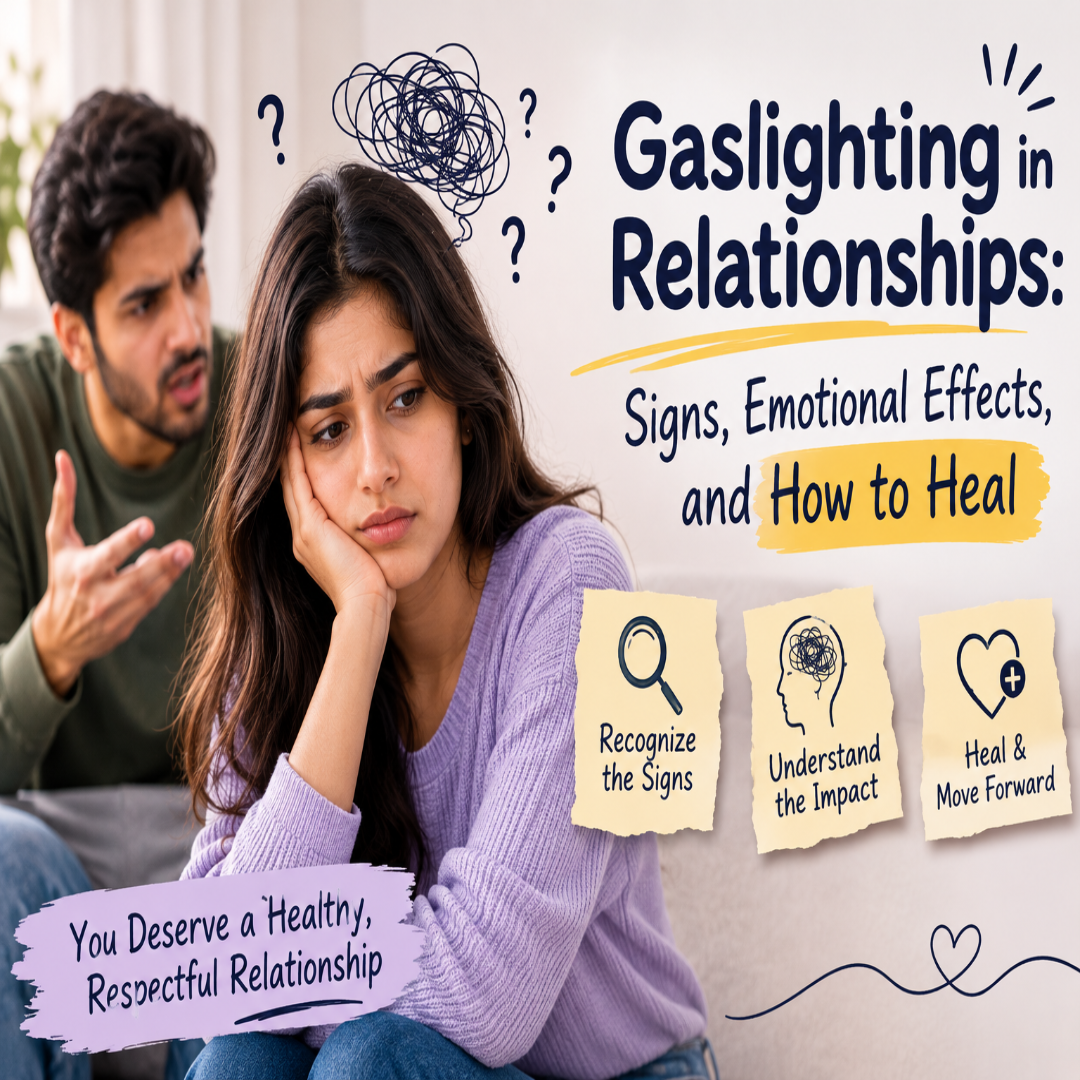
Gaslighting in Relationships: Signs, Emotional Effects, and How to Heal
Relationships are built on trust, respect, emotional safety, and honest communication. However, when one partner repeatedly makes the other question their memories, feelings, or understanding of situations, the relationship can become emotionally exhausting. This behaviour may be a form of gaslighting in a relationship.
Gaslighting in a relationship can be difficult to recognize because it often develops gradually. What begins as confusion after an argument may eventually turn into constant self-doubt, anxiety, and a loss of confidence in one's own judgment.
Understanding the signs of gaslighting, its effects on mental health, and the steps you can take to protect your emotional well-being is an important part of building healthier relationships.
What Is Gaslighting in a Relationship?
Gaslighting is a pattern of psychological manipulation in which one person repeatedly distorts, denies, or dismisses another person's experiences, making them question their own perception of reality.
In romantic relationships, gaslighting may involve denying things that happened, rewriting past conversations, blaming a partner for the manipulator's behaviour, or making their emotional reactions seem unreasonable.
For example, imagine that you clearly remember your partner making a hurtful comment. When you bring it up, they insist that it never happened and tell you that you are too sensitive or that your memory cannot be trusted. If this becomes a repeated pattern, you may eventually begin questioning whether your experience was valid.
It is important to remember that not every disagreement, misunderstanding, or denial is gaslighting. People can remember events differently or become defensive during arguments. Gaslighting is more concerning when there is a repeated pattern of manipulation that undermines someone's confidence in their own reality.
Signs of Gaslighting in a Relationship
Recognizing gaslighting can be challenging, especially when you care deeply about your partner and want the relationship to work. Here are some common signs of gaslighting in a relationship that may help you identify unhealthy patterns.
1. Constantly Denying Things That Happened
Your partner repeatedly denies conversations, promises, or actions that you clearly remember. They might say, “I never said that,” even when you remember the conversation in detail. Over time, these repeated denials can make you question your memory and judgment.
2. Making You Feel Too Sensitive
Whenever you express hurt or disappointment, your partner dismisses your feelings instead of trying to understand them. You might hear statements such as, “You're overreacting,” “You make everything a big deal,” or “You can't take a joke.” Although partners may occasionally disagree about emotional reactions, consistently invalidating your feelings can make it difficult to express yourself openly.
3. Turning Every Argument Against You
A conversation that begins with your concern somehow ends with you apologizing for bringing it up. For instance, you tell your partner that a particular comment hurt you, but they shift the discussion toward your tone, your past mistakes, or your supposed inability to understand them. This pattern can prevent genuine accountability and leave your original concern unresolved.
4. Making You Doubt Your Own Memory or Judgment
One of the most significant signs of gaslighting is repeatedly questioning your ability to understand situations accurately. You may start asking yourself:
● Did that conversation actually happen the way I remember?
● Am I being unreasonable?
● Am I misunderstanding everything?
● Should I trust my own feelings?
When these questions become frequent because of your partner's repeated behaviour, it may indicate an unhealthy pattern of emotional manipulation.
5. Using Guilt to Control Your Emotions
Your partner may make you feel responsible for their anger, jealousy, or hurtful actions. For example, they might say, “I wouldn't have shouted if you hadn't provoked me.” While both partners are responsible for how they communicate, one person is not responsible for another person's decision to insult, threaten, or intimidate them.
6. Making You Feel Like You Are Always the Problem
In an unhealthy relationship, one partner may consistently avoid responsibility and portray the other as the source of every conflict. You may find yourself apologizing frequently, even when you are unsure what you did wrong. Eventually, you might begin believing that you are difficult to love or that you are responsible for keeping the relationship peaceful at any cost.
7. Dismissing Your Feelings and Experiences
When you share your concerns, your partner may laugh at you, mock your emotions, or insist that your interpretation is completely wrong. The issue is not that your partner has a different perspective. It is that your perspective is repeatedly dismissed without genuine discussion or consideration.
Common Gaslighting Phrases: What to Watch For
Gaslighting phrases are not defined by the words alone. Their meaning depends on how they are used, how frequently they occur, and whether they form part of a repeated pattern of manipulation.
Some phrases can be warning signs when they are repeatedly used to deny reality, shift blame, or undermine your confidence:
● “That never happened.”
● “You're imagining things.”
● “You're too sensitive.”
● “You're always overthinking.”
● “You're remembering it wrong.”
● “You're the reason I behave this way.”
● “Nobody else would put up with you.”
● “You're making a big deal out of nothing.”
● “You're crazy. You need help.”
● “I was only joking. You can't take anything.”
These phrases do not automatically prove gaslighting. Their meaning depends on the context, intention, and, most importantly, the pattern of behaviour surrounding them.
How Gaslighting Affects Mental Health
Gaslighting can gradually affect how a person sees themselves, understands their emotions, and approaches relationships. When someone repeatedly questions your reality, you may begin to rely more on their version of events than your own experiences.
Self-Doubt and Loss of Confidence
One of the common emotional effects of gaslighting in relationships is persistent self-doubt. You may stop trusting your decisions, second-guess your memories, or feel the need to seek reassurance before expressing an opinion. Even simple decisions can begin to feel overwhelming when you no longer feel confident in your own judgment.
Anxiety and Constant Overthinking
Gaslighting can create uncertainty about how your partner will respond to your words or actions. You may replay conversations repeatedly, prepare yourself for arguments, or worry about saying something that might upset them. This can contribute to anxiety, emotional exhaustion, and difficulty relaxing within the relationship.
Reduced Self-Esteem
When your feelings and experiences are repeatedly dismissed, you may begin to internalize the negative messages you receive. Thoughts such as “Maybe I am the problem” or “Maybe I am not good enough” can become increasingly familiar. Over time, this can affect your self-worth and make you feel less deserving of respect, affection, and emotional security.
Emotional Confusion and Exhaustion
You may experience conflicting emotions. You might love your partner while also feeling hurt by their behaviour. You may remember the good moments and wonder whether the painful experiences are serious enough to address. This emotional conflict can make it difficult to decide what you want from the relationship.
Difficulty Trusting Others
Long-term emotional manipulation can affect how you approach future relationships. You may become cautious about expressing vulnerability, find it difficult to trust reassurance, or worry that another person might eventually treat you the same way. These effects are not inevitable, and recovery is possible. Supportive relationships, healthy boundaries, and professional help can gradually rebuild a sense of safety and confidence.
Difficulty Concentrating and Making Decisions
When someone frequently questions their own memories and judgment, they may find it difficult to concentrate, make everyday decisions, or feel confident about their choices. This uncertainty can affect work, studies, relationships, and other areas of daily life.
How to Deal With Gaslighting in a Relationship
Recognizing gaslighting is an important first step, but deciding how to respond can be difficult. You may want to protect the relationship while also protecting your mental health. Here are some practical ways to begin.
1. Pay Attention to Repeated Patterns
Instead of focusing on one argument, consider what happens repeatedly. Ask yourself:
● Are my concerns acknowledged or consistently dismissed?
● Can my partner take responsibility for their actions?
● Do disagreements lead to mutual understanding, or do I always end up feeling guilty?
● Do I feel emotionally safe expressing my thoughts?
These questions can help you understand whether the relationship involves occasional conflict or a persistent pattern of manipulation.
2. Keep a Record of Your Experiences if It Is Safe
If you frequently find yourself questioning what happened, you may find it helpful to write down important conversations, events, and your emotional responses. The purpose is not to collect evidence to win arguments. It is to help you maintain clarity about your experiences and recognize recurring patterns. Keep any notes somewhere private and secure if you are concerned about your partner's reaction.
3. Learn How to Respond to Gaslighting
You do not need your partner's agreement to acknowledge that an interaction has affected you. You can express your perspective calmly while deciding what boundaries you need. You can use calm, clear statements such as:
● “I remember the conversation differently, and I don't want to argue about whether my feelings are valid.”
● “You may not agree with my perspective, but I need you to listen without insulting me.”
● “I am willing to discuss the issue, but not if the conversation involves blaming or name-calling.”
● “I need some time to think about what happened before continuing this conversation.”
The goal is not to win the argument. It is to communicate your perspective while protecting your emotional well-being.
4. Set Clear Boundaries
Learning how to set boundaries with a gaslighting partner involves identifying what behaviour you will not accept and what you will do if it continues. For example, you might say, “I am willing to discuss disagreements, but I will take a break from the conversation if it becomes insulting.”
A boundary is about your own actions, not controlling another person's behaviour. Your partner may not agree with your boundary, but their response can provide useful information about whether they respect your needs. If setting boundaries could put you at risk of intimidation or violence, prioritize your safety and seek confidential support rather than confronting your partner alone.
5. Reach Out to Someone You Trust
Emotional manipulation can make you feel isolated, particularly if you have started questioning your own judgment. Speaking with a trusted friend, family member, or mental health professional can help you gain perspective and feel less alone. Choose someone who listens without pressuring you into making immediate decisions. You deserve support that helps you think clearly rather than adding to your confusion.
6. Remember That You Cannot Change Someone Alone
A healthier relationship requires accountability and effort from both partners. If your partner consistently denies harmful behaviour, refuses to take responsibility, or uses your vulnerabilities against you, it is important to recognize that you cannot repair the relationship through your efforts alone. You are allowed to reconsider the relationship if it continues to harm your emotional well-being.
How to Rebuild Self-Confidence After Gaslighting
Recovering from gaslighting is not simply about leaving an unhealthy relationship or deciding that the other person was wrong. It also involves rebuilding trust in yourself.
Reconnect With Your Own Feelings
Start by acknowledging what you feel without immediately judging or dismissing it. Instead of asking, “Am I overreacting?”, try asking, “What about this situation hurt me, and what do I need right now?” Your feelings are not always a complete account of another person's intentions, but they are meaningful information about your own experience.
Practice Making Small Decisions Independently
If you have become accustomed to doubting yourself, begin with everyday choices. Decide what you want to eat, how you would like to spend your time, or whether you feel comfortable agreeing to a request. Notice your preferences without automatically seeking someone else's approval. Small decisions can help you rebuild confidence in your ability to make choices.
Challenge Self-Blaming Thoughts
When you notice thoughts such as “Everything is my fault,” pause and examine them. Ask yourself:
● What facts support this thought?
● Am I taking responsibility for something that was not entirely within my control?
● Would I blame a friend in the same situation?
● Is there a more balanced way to understand what happened?
The aim is not to replace every negative thought with a positive one. It is to develop a more realistic and compassionate understanding of yourself.
Rebuild Connections Outside the Relationship
Spend time with people who respect your individuality and encourage you to express yourself. Reconnecting with hobbies, interests, routines, and supportive friendships can help you rediscover parts of yourself that may have been neglected during the relationship.
Give Yourself Time to Heal
Recovery is not always linear. You may feel confident one day and question your decisions the next. You do not need to have everything figured out immediately. Healing involves gradually learning that you can acknowledge difficult experiences, make decisions, and seek relationships in which respect and accountability are mutual.
When to Seek Professional Support After Gaslighting
If gaslighting has affected your confidence, emotional stability, or ability to trust yourself, professional support may help you understand your experiences and develop healthier coping strategies.
How Therapy Can Help After Gaslighting
Therapy can provide a confidential, non-judgmental space where you can explore what happened without feeling pressured to defend your emotions. Depending on your needs, therapy may help you:
● Identify patterns of emotional manipulation and unhealthy communication.
● Understand the effects of repeated invalidation on your self-esteem.
● Challenge self-blaming thoughts and persistent self-doubt.
● Develop practical strategies for setting and maintaining boundaries.
● Manage anxiety, rumination, and emotional distress.
● Rebuild confidence in your decisions and personal values.
● Explore relationship choices in a way that respects your autonomy.
Approaches such as cognitive behavioural therapy (CBT) may help you examine unhelpful thought patterns, while other therapeutic approaches may focus on emotional processing, relationship patterns, and restoring a sense of safety.
Therapy for Emotional Abuse and Gaslighting
Therapy for emotional abuse and gaslighting should focus on your safety, individual needs, and recovery rather than simply teaching you how to tolerate harmful behaviour. If you are currently in a relationship involving intimidation, coercion, or ongoing emotional abuse, an individual therapist can help you assess your options and develop a safety plan where needed.
Relationship counselling may be helpful when both partners can participate voluntarily, communicate safely, and take responsibility for their behaviour. However, couples therapy may be inappropriate where there is ongoing abuse, coercive control, or fear of retaliation. In such situations, individual support and specialist guidance are generally safer starting points.
Online Counselling for Relationship Manipulation
For people who find it difficult to attend in-person sessions, online counselling for relationship manipulation can offer a more accessible way to seek support. Online sessions may help you explore relationship concerns, understand recurring emotional patterns, and work towards rebuilding your self-esteem.
If your partner monitors your devices or communications, consider whether online sessions and messages can be accessed safely before arranging support. Seeking psychological support after an emotionally abusive relationship is not a sign of weakness. It is a step towards understanding your experiences and creating healthier patterns for the future.
6. Can a Relationship Recover From Gaslighting?
In some situations, a relationship may improve if the harmful behaviour stops and both partners genuinely work towards change. However, rebuilding trust requires more than apologies or temporary improvements.
Meaningful change involves acknowledging specific actions, taking responsibility without shifting blame, respecting boundaries, and demonstrating consistent behavioural change over time.
If the same pattern continues despite repeated conversations, you do not have to keep giving chances at the expense of your mental health. You also do not need to prove that your partner intentionally manipulated you before deciding that a relationship is unhealthy for you. The impact of the behaviour and your emotional safety matter.
Ultimately, the decision to stay, seek support, or leave belongs to you. A therapist can help you explore these choices without making the decision on your behalf.
Final Thoughts: You Deserve a Relationship Where You Feel Safe
Gaslighting can gradually make you question your memories, feelings, and worth. When this happens within a romantic relationship, it can become difficult to distinguish healthy compromise from repeatedly silencing yourself to maintain peace.
Recognizing the signs of gaslighting in a relationship is an important step towards understanding what you are experiencing. Learning how to respond to gaslighting, establish boundaries, and rebuild self-confidence can help you regain a sense of control over your own life.
A healthy relationship does not require you to agree on everything. It allows room for different perspectives, honest disagreements, accountability, and mutual respect.
You can acknowledge another person's perspective without abandoning your own. You can love someone while recognizing that certain behaviours are hurting you. And you can seek support without having to justify why you need it.
If relationship manipulation is affecting your mental health, professional counselling can help you understand your experiences, strengthen your boundaries, and work towards emotional recovery. You deserve relationships in which your feelings are heard, your individuality is respected, and you feel safe being yourself.
