
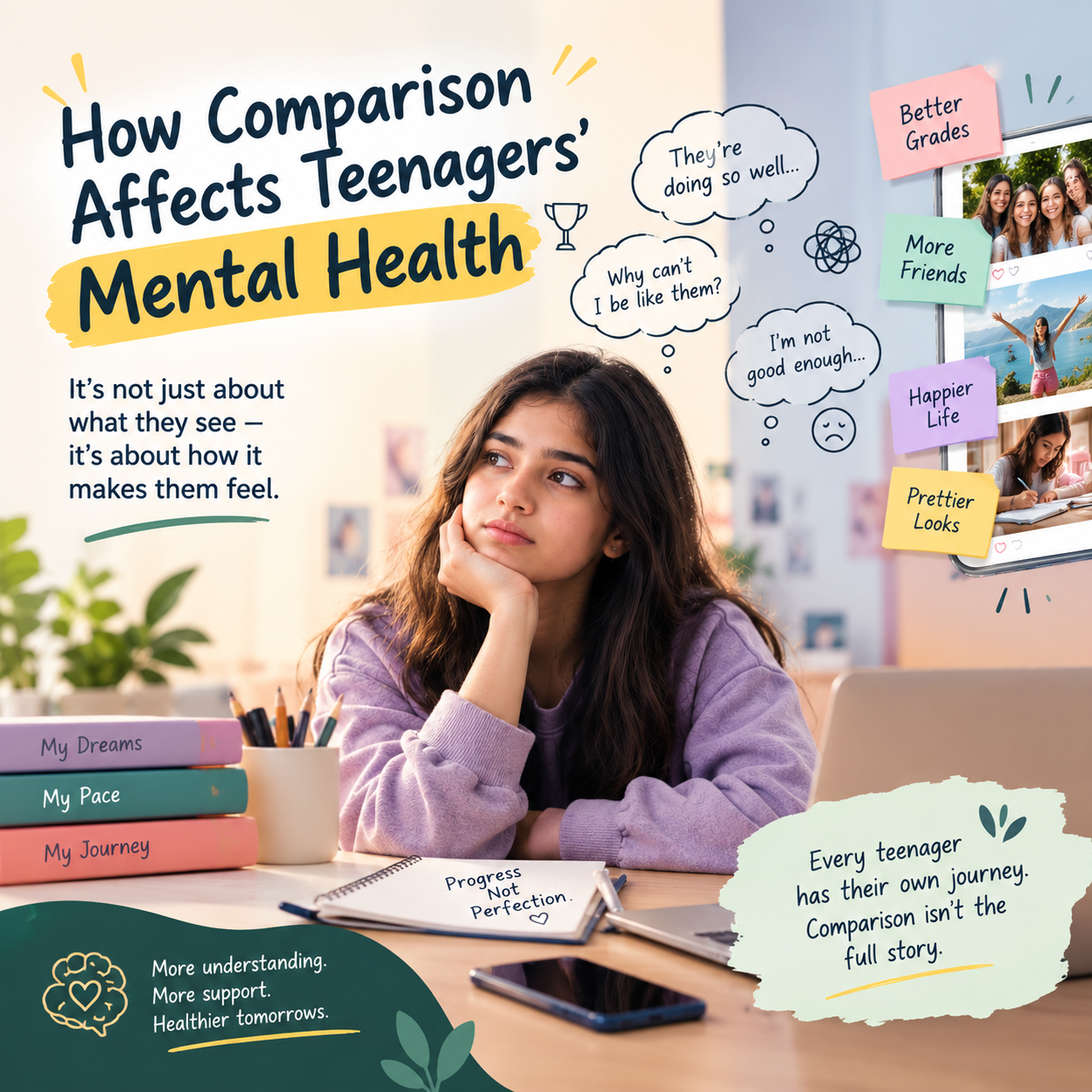
How Comparison Affects Teenagers' Mental Health
Comparison is a common part of growing up, especially during the teenage years. From academic results and family expectations to friendships and social media, teenagers are constantly exposed to situations that encourage them to measure themselves against others.
A parent casually saying "look how well your cousin is doing" or a teacher holding up one student as the benchmark for the rest of the class might seem harmless in the moment. But for a teenager, those words land very differently. They do not hear encouragement. They hear that they are not enough. And when that message keeps repeating, it starts to shape how they see themselves.
This is something we see consistently in child and teenage counselling. Young people who are constantly compared to others, whether siblings, classmates, or even idealized versions of who they "should" be, often carry a quiet but heavy burden of inadequacy. It does not always show up as sadness or crying. Sometimes it shows up as withdrawal. Sometimes as anger. Sometimes as a teenager who simply stops trying because they have already decided, deep down, that they cannot win.
Why Does Comparison Feel Normal but Hurt Teenagers?
Comparison is practically built into the way teenagers grow up in India. School rankings, report card discussions at family gatherings, competitive entrance exams, social media highlight reels. From every direction, teenagers are receiving one clear message: measure yourself against others and find out where you stand.
The problem is that this kind of social comparison rarely motivates teenagers in a healthy way. Psychological research suggests that frequent social comparison can negatively affect teenagers' self-esteem, particularly when they begin to measure their personal worth through academic performance, appearance, popularity or achievements. The teenager does not think "I will work harder." They think "I will never be as good as them." That shift, from a growth mindset to a fixed one, is where comparison does its most lasting damage.
How Social Media Comparison Affects Teenagers
Social media comparison affects teenage mental health in ways that are harder to see because they happen privately, on a screen, usually at night when no adult is around. A teenager scrolling through Instagram at midnight is watching a curated version of everyone else's life: the best grades, the best holidays, the best friendships, the best bodies. And they are comparing all of that to how they actually feel inside.
This is an unequal comparison and teenagers know it, but knowing it does not make it hurt less. Over time, repeated exposure to idealised versions of other people's lives may contribute to insecurity, anxiety, dissatisfaction with one's appearance and feelings of not belonging. For some teenagers, these experiences may also be associated with depressive symptoms.
How Parental Comparison Affects Teenagers' Self-Esteem
Parents who compare their children with other children almost always do it out of love. They want their child to do better. They want to push them toward their potential. But the way comparison lands in a child's mind is rarely what the parent intended.
Instead of focusing only on marks or achievements, parents can recognise effort, individual strengths, improvement and the challenges their teenager is working through.
When a parent says "your friend Rohit got 90, why did you only get 72", the child does not hear "I believe in your potential." They hear "you are less than Rohit." And when this happens repeatedly, it does not create ambition. It creates a child who is afraid to fail, afraid to try new things, and deeply unsure of their own worth outside of a grade or a result.
The psychological effects of comparing siblings are often even more intense. Brothers and sisters live in the same house. They share meals, parents, and memories. When one is consistently held up as the "better" one, the other does not just feel inadequate at school. They feel inadequate at home, in the one place where they should feel completely safe.
Signs That Comparison Is Affecting Your Teenager
Children and teenagers dealing with the effects of comparison do not always say it out loud. But they show it. Some signs to pay attention to:
• Saying things like "I am just not smart" or "I can never do anything right"
• Giving up quickly on tasks they find difficult
• Becoming anxious or upset before exams, even when they have prepared well
• Avoiding social situations because they feel they do not measure up
• Becoming irritable or withdrawn after family gatherings
• Overworking to the point of exhaustion, trying to finally be "enough"
These are not signs of a difficult child. They are signs of a child who has received the message, in one way or another, that who they are is not quite good enough. That is a painful place to live.
How Academic Comparison Affects Teenagers' Mental Health
Academic comparison and teenage stress are almost inseparable in the Indian context. Board exams, entrance tests, college cutoffs: the pressure teenagers face around education is immense. When comparison is added on top of that, the stress does not just increase. It changes in character.
A teenager who is stressed about an exam can still study and manage. But a teenager who is stressed about an exam and also convinced that they are fundamentally less capable than their peers is carrying a different kind of weight. The stress is no longer just about the test. It is about identity. It is about whether they are worth anything at all if they do not score well. That is when comparison becomes genuinely dangerous to mental health.
Academic comparison can also make teenagers question their abilities, interests and future choices. They may begin choosing subjects or career paths based on what others expect rather than what genuinely interests them. Many teenagers who feel overwhelmed by academic pressure are not actually failing; they are simply stuck in a comparison loop where no achievement feels like enough. Proper career counselling helps them step out of that loop, understand their own strengths, and make decisions based on who they actually are rather than who they think they should be.
How Parents Can Help Teenagers Handle Comparison
· Avoid comparing marks, appearance, behaviour or achievements with siblings and classmates.
· Appreciate effort instead of focusing only on results.
· Encourage teenagers to identify their own interests and strengths.
· Listen without immediately criticising or offering solutions.
· Make home a space where mistakes can be discussed without fear of judgement.
The good news is that parents have more influence here than they often realise, and changing the pattern does not require a complete overhaul of how you parent. It starts with small but meaningful shifts in language.
Instead of comparing your child to someone else, compare them to themselves. "You struggled with this chapter last month and now you have got it" is a sentence that builds confidence. "Your classmate already finished this" is a sentence that builds anxiety. The content is almost the same. The effect is completely different.
How to build a child's self-confidence is not about telling them they are the best at everything. It is about helping them see their own progress. It is about making it safe for them to try things they are not yet good at. It is about separating your love and approval from their performance. Children who feel loved regardless of results are far more likely to take healthy risks, recover from setbacks, and develop genuine resilience.
When Should Teenagers Seek Professional Support?
If comparison is affecting a teenager's confidence, relationships, academic life or emotional wellbeing, talking to a trained mental health professional may help. Child and teenage counselling can provide a supportive space where young people can express their feelings, understand negative self-beliefs and develop healthier ways of viewing themselves.
Sometimes the effects of comparison go deep enough that a parent's changed language is not enough on its own. This is not a failure. It simply means the child or teenager has been carrying this for a while and needs a space outside the family to process it.
Child and teenage counseling offers exactly that. A trained counselor gives young people a place to speak honestly about how they feel without worrying about disappointing anyone. In that kind of space, teenagers who have been told for years that they are "not as good as" someone else often begin to discover that their self-worth was never actually connected to those comparisons in the first place.
Counseling for teenagers with low self-esteem does not mean something is broken. It means a young person is getting support before a pattern of thinking becomes something they carry into adulthood. It is one of the most practical investments a parent can make in their child's long-term wellbeing.
Career counseling is also worth considering for older teenagers who are feeling lost or overwhelmed about their future. Much of what looks like confusion about career direction is actually confusion about identity, driven by years of being compared to others. Career counseling helps teenagers identify their genuine interests and strengths, separate their own voice from the noise of expectations around them.
Every Teenager Has Their Own Pace
There is no single timeline for growing up well. Some children bloom early, some take longer, and most do not follow the pattern that looks most impressive at a family dinner. What every child does need, without exception, is the feeling that they are seen for who they are rather than measured against someone they are not.
If your teenager is struggling with comparison, with insecurity, with anxiety around school or friendships, they are not unusual. They are navigating something genuinely difficult in a world that does not make it easy. The most powerful thing you can do is make sure they do not have to navigate it alone.
At Well Hope, we offer child and teenage counseling, career counseling, and family support for exactly these situations. If you are not sure where to start, a single conversation can help.
Reach out to us to book a session for your child or teenager.
